AI and resource governance / Preprint awaiting review 1.0
People First: A Framework for AI, Land, Water, and Economic Power
A proposed prohibition on AI ownership and autonomous expansion, with a dry-day test for protecting essential resources
Who controls the land, water and capital when an AI recommends a purchase?
The framework examines beneficial control, human authorization and resource allocation when automated decisions can compound.
- Independent requirements
- 2Accountable human authority and protected resource access.
- Illustrative water cases
- 5One fictional daily delivery budget under different demands and supply conditions.
- Capital scenarios
- 3Invented returns illustrate sensitivity of a five-year reinvestment example.
Abstract
An AI system that can earn revenue, retain profits and authorize its next investment could gain practical power over land, infrastructure and labor even if a corporation holds legal title. We examine this possibility as a governance risk. Primary legal texts distinguish corporate ownership, board authority and acts attributable to a human or corporate principal. National laboratory estimates document substantial data center resource use, while the self-financing scenario remains hypothetical. We propose prohibiting AI ownership and independent authority over consequential acquisitions and managerial decisions. A separate public test reserves water, food access, essential land uses and enforceable existing obligations before a new covered load can proceed. In a constructed daily water budget, proposed demand of 9 million liters leaves a 2-million-liter surplus under normal supply and a 3-million-liter shortfall under design stress. A redesigned load of 5 fits the design stress but fails a more severe scenario. These cases illustrate why ownership review and physical resource limits are complementary. We specify evidence, appeal and enforcement procedures and identify tradeoffs involving legitimate automation, administrative burden and essential computing services.
- AI ownership
- economic control
- drinking water
- food security
- land use
- data centers
- worker rights
Contributions
- A proposed prohibition on machine ownership and effective economic control, with a test of whether a person can genuinely refuse a consequential commitment.
- Separate resource, land-access and labor protections that apply even when a business has a lawful human-governed owner.
- An auditable five-case stress test showing how supply, demand and operating conditions change the disposition of a fictional data center application.
1. Who gets the last unit of water?
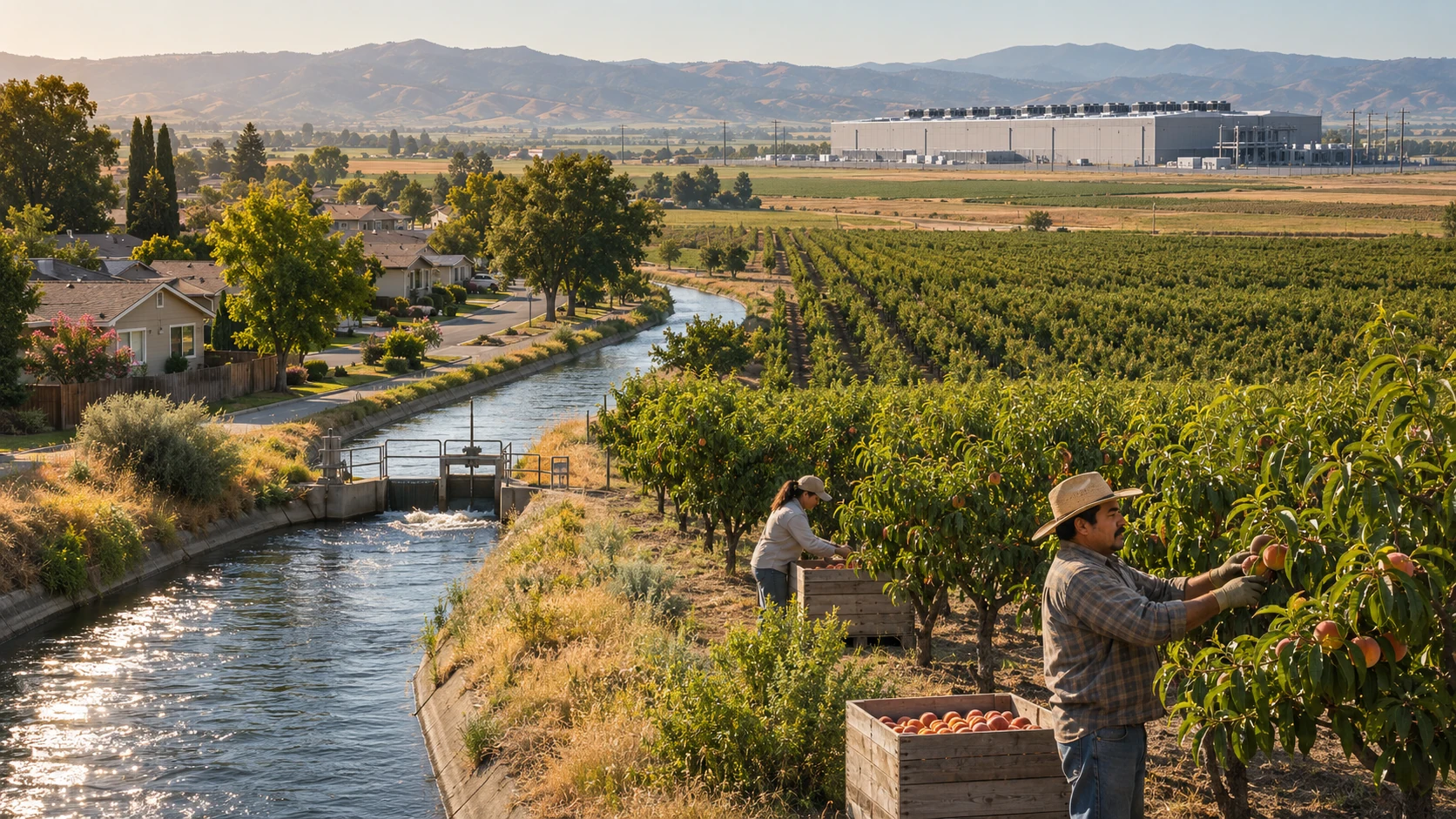
Picture a town with enough drinking water in an ordinary summer and barely enough in a hot, dry one. A company offers good jobs and higher tax revenue if it can build a data center. Its planning software says the project will pay for itself. The town still has to answer two questions. Who has the power to commit the land and the water? What happens to the people already depending on those resources during a shortage? A cash-flow forecast answers neither question.
We propose a rule with two requirements. A person or a legally accountable human-governed institution must own the assets and make the consequential decisions. A project also has to fit inside resource limits set after protecting people’s drinking water, sanitation, food access and essential land uses. It can fail either test. A founder who personally signs every document still cannot spend the town’s drought reserve. A machine with a very efficient cooling design still cannot acquire land on its own authority.
This distinction matters for ordinary people using ordinary tools. A farmer can ask software to suggest an irrigation schedule. A clinic can use a computer service to schedule appointments. Neither example gives a model a claim on profits or authority to buy the next field. Our proposal protects those uses while reserving decisions about ownership, expansion and livelihood to accountable people. A farmer, a worker and a patient should each be able to discover who made a consequential decision, challenge it and obtain a timely remedy.
2. How we tested the proposal
We used three forms of evidence. First, we read primary legal texts about corporate property, directors and electronic agents. We used California agencies’ accounts of drinking water, agricultural land and employment rules for the public decisions in the case. Second, we reviewed two national laboratory reports to identify infrastructure demands that have already been estimated. Third, we constructed numerical cases that can be recomputed by hand. Each kind of evidence answers a different question. Legal texts establish some of the powers and constraints a proposal would encounter. National estimates establish scale. Invented cases test what the proposed rule would decide under stated assumptions. [1][2][3][4][5][6][7][8]
The legal illustration concerns a Delaware corporation considering a facility in California. The distinction between the state of incorporation and the location of the land is intentional. Corporate authority, site approvals and resource rights may involve different institutions. We make no claim that one city council can rewrite corporate law or reallocate a watershed. Implementing the full proposal would require legislation and coordination among bodies with the relevant authority. Transactions in other countries need their own analysis of title, corporate power, water rights, labor rights and due process.
The comparison is a policy design exercise. We did not sample companies, measure AI profitability, survey residents or inspect a real permit. The fictional water budget is deliberately small enough to audit. Its parameters do not describe a particular California community. A useful result is a case in which changing only the resource demand or who may authorize it changes the decision for an intelligible reason. The examples can expose inconsistent rules even though they cannot estimate how many projects would be affected.
3. A deed, a board and an electronic agent
Under Delaware’s general corporation law, a corporation has an express power to acquire and hold real and personal property. Its board generally manages or directs its business and affairs, subject to the exceptions stated in the statute. Members of the board must be natural persons. A deed naming a corporation can therefore identify a lawful owner while saying little about the software, contract terms or staff decisions that led to the purchase. These provisions describe one corporate form. They do not establish a worldwide rule about machine ownership. [1][2]
Federal electronic-signature law addresses a different part of the problem. For covered transactions affecting interstate or foreign commerce, section 7001(h) protects an agreement or record against denial of legal effect solely on the ground that an electronic agent participated, provided the agent’s action is legally attributable to the person to be bound. The attribution condition matters. The statute addresses the effect of the means used to form or deliver the record. Treating a software-generated transaction as potentially binding on a human or company does not turn the software into a titleholder. [3]
The ambiguity that motivates our proposal arises when a human institution remains the named buyer yet the software chooses the asset, the amount, the financing and the timing, and the people listed as controllers lack either discretion or time to intervene. Checking for a human name in a registry will miss that arrangement. Declaring all electronic transactions void would disrupt routine commerce. The legal question for a new statute is what authority a human principal may delegate, what it must reserve, and what evidence establishes that the reservation works.
Table 1. Existing reference points and proposed additions
| Reference point | What it establishes | Proposed addition |
|---|---|---|
| Delaware corporate law | A corporation can hold property. Directors are natural persons. [1][2] | Show who can refuse a specific acquisition and redirect retained earnings. |
| Federal electronic signatures | Software participation can be consistent with a binding act of a person. [3] | Reserve listed high-impact commitments for a documented human decision. |
| California water policy | State law recognizes a human right to water for specified basic uses. [4] | Require a stress-period resource showing before a new covered load is committed. |
| California farmland review | Maps inform project-level assessment and agency judgment. [5] | Require evidence of continued access to productive and essential land. |
4. The demand that already exists
Lawrence Berkeley National Laboratory’s June 2026 update estimates that US data centers used 192 terawatt-hours of electricity in 2024, about 4.7% of national electricity consumption. Its estimates draw on equipment shipments and modeling assumptions, and the report explains changes from its earlier estimates. The annual sector estimate excludes cryptocurrency mining. It includes conventional computing as well as AI-related equipment. It cannot identify which service caused the cost of a particular interconnection or outage. [6]
The laboratory’s 2024 report estimated approximately 66 billion liters of direct water consumption across US data centers in 2023. Direct consumption at a facility and water used to generate its electricity are separate accounting boundaries. On-site withdrawal, discharge and consumption are also distinct. A utility responsible for delivering water needs to know the amount and timing it must supply. A watershed authority may care particularly about the volume, quality, timing and location of water returned. One national annual estimate determines neither quantity in a given town. [7]
A local application should therefore identify its actual source, treatment requirements, discharge arrangements and expected peak demand. A project proposing reclaimed water should specify who already uses it and what supplying it would displace. A change in cooling equipment may reduce local withdrawals while raising electricity demand or affecting another community through electricity generation. Each competent authority should see the same assumptions. The applicant should report which burdens move, which fall, and who bears the cost of uncertainty.
5. When profit becomes permission to expand
Consider a hypothetical firm that delegates pricing, cash allocation, site selection and labor allocation to one adaptive system. If a period of high earnings automatically enlarges the system’s spending authority, financial success buys a larger set of future choices. Human owners can accumulate resources this way too. The distinctive concern here is the removal of a responsible decision maker at the moment that earnings are turned into new rights over land, infrastructure or work. Higher operating speed could compound the governance problem if public review still takes months.
The arithmetic of accumulation is easy, which is why it can be misleading. Start with 20 million dollars. If net capital grows by 25% each year and everything remains available to reinvest, five years produces about 61.04 million dollars. At 0% it stays at 20 million. With a 10% annual loss it falls to about 11.81 million. These are the results of multiplying the opening balance by 1.25, 1.00 or 0.90 five times. Each path is invented. The positive path assumes away competition, borrowing limits, taxes beyond the assumed net return and constraints on physical expansion. It offers no evidence that an AI can sustain that return, acquire a monopoly or capture all wealth.
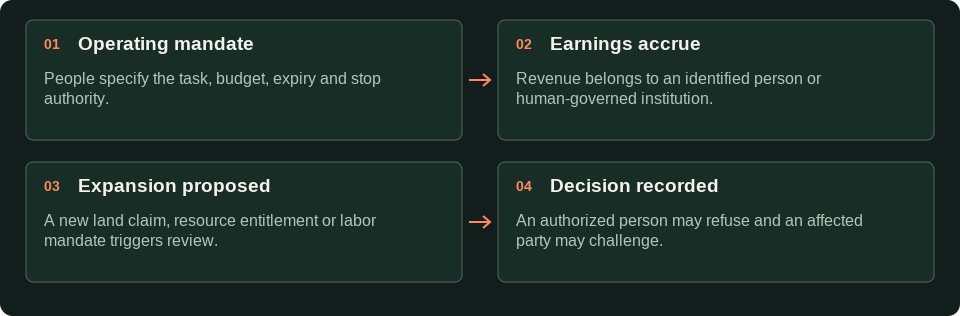
A defense that waits to prove permanent monopoly would start too late for a family whose lease has already been terminated or a utility that has already contracted away dry-year capacity. We instead define the protected decision by its consequences. An automated estimate of next quarter’s sales is ordinary advice. Using revenue to bind another parcel or to assign management power over a workforce requires fresh authority. Higher profits cannot expand the scope of the original authorization.
Figure 1. Where a new act of authority is required
- Operating mandate
People specify the task, budget, expiry and stop authority.
- Earnings accrue
Revenue belongs to an identified person or human-governed institution.
- Expansion proposed
A new land claim, resource entitlement or labor mandate triggers review.
- Decision recorded
An authorized person may refuse and an affected party may challenge.
6. A prohibition that follows decision rights
The proposed statute would deny an AI system the capacity to hold title, a beneficial claim, a residual right to profits or independent authority over a portfolio. A legal entity seeking a covered transaction must identify the people who can authorize, withhold and terminate it. It must also identify whose economic interests receive the upside and whose assets back the liabilities. The inquiry follows voting arrangements, management mandates, financing terms and actual decision records. Human-governed companies, cooperatives, public agencies and tribal governments can hold assets within their own lawful governance systems. An agency could document accountable officeholders and public authority without inventing a private beneficiary for public land.
The Financial Action Task Force defines a beneficial owner in its legal-person framework by reference to natural persons who ultimately own or control, including through effective control. That definition provides a useful design precedent. It belongs to anti-money-laundering standards and does not itself impose the proposed AI restriction. We borrow the question about ultimate authority and add a question specific to automation. Can an identified human actually decline the next commitment, without instructions from the software or an automatic financial consequence that makes refusal fictitious? [9]
The applicant would submit one completed decision record and one observed refusal or realistic refusal exercise. The record should identify the alternatives available, the documents the responsible person received, the deadline, and what happened while the decision was pending. A reviewer must be able to see that the institution can preserve a refusal in practice. If every request converts into a binding commitment unless someone discovers and reverses it overnight, the claimed human authority is inadequate. An uninterpretable ownership chain or missing evidence of control is grounds to defer authorization and specify what must be cured. It is not by itself proof of fraud.
Covered decisions include acquiring or selling land, taking a lease that confers comparable long-term control, committing new water capacity, financing a new data center, expanding the envelope for reinvestment and delegating consequential managerial powers. Related proposals drawing on the same committed capacity or governed by the same decision mandate should be reviewed cumulatively. Limited, revocable automation can execute a previously approved payment or dispatch equipment within a fixed operating envelope. It cannot enlarge that envelope by changing its own limits, choosing its own overseer or claiming its own earnings.
7. How people set the resource floor
California recognizes a human right to water adequate for drinking, cooking and sanitation, with safety, affordability and accessibility integral to the policy. These dimensions belong together. A water connection a family cannot afford, or a source that cannot meet drinking standards, does not secure basic service. Section 106.3 supplies a public basis for deliberation about human needs. Subdivision (c) preserves the existing scope of the state’s obligation to provide water or fund water infrastructure. It does not supply the numerical budget in this paper or settle every competing claim to a water source. [4]
The permitting body should first identify the authority and geography for each ledger. A district can estimate treated drinking-water delivery in its own service area. A watershed body can assess downstream flow and quality. Tribal water and land rights require identification and engagement with the relevant sovereign authorities. A general public meeting offers no substitute for respecting jurisdiction, existing rights or applicable consultation duties. The capacity deducted as protected needs must avoid counting the same underlying delivery twice. Food production deserves an explicit, publicly justified allocation where irrigation and the proposed industrial user genuinely compete for a defined supply. A wealthy agricultural exporter cannot establish a claim on all available water by invoking the word food.
Land also needs a geographic and functional description. California’s Department of Conservation explains how Important Farmland maps inform project-level agricultural impact assessment and how the lead agency evaluates significance. A map category offers a starting point for field review. It cannot reveal by itself who can afford nearby housing, whether an irrigation route would be severed or whether affected growers can obtain an equivalent parcel. We propose adding evidence of present use, access, replacement time and cumulative conversion to the site record. A promised cash payment should not satisfy a physical access requirement unless the authority can identify a real replacement with enforceable terms. [5]
8. A reproducible dry-day decision
All figures here are invented daily deliveries of treated water, in millions of liters per day. Assume that one utility supplies households, a locally designated food-production commitment, known downstream or other obligations, and the proposed facility from the same constrained system. Let deliverable supply be 100 on an ordinary day, 95 under the design stress, and 92 under a more severe stress. The policy reserves 55 for domestic essentials, 15 for the food commitment, 10 for environmental and other obligations, and 5 for uncertainty. These mutually exclusive amounts total 85. Existing covered industrial demand uses a further 4. The illustrative headroom for a new project is supply minus 89.
An application seeking 9 has a surplus of 2 under ordinary conditions and a shortfall of 3 at the design stress. The original application fails. A revised design needing 5 passes the design stress by 1. On the severe day it falls short by 2. Even at the design stress, a hot-weather increase to 6.5 produces a deficit of 0.5. A promise to curtail has value only if an identified operator can reduce the load in time, the facility and utility can verify the reduction, and affected workers and essential services have a continuity plan. A protected floor should remain feasible after any single action that the authority is being asked to approve.
Suppose the original site also converts six hectares of actively cultivated land and the alternative occupies an already developed parcel. Those are scenario facts, not evidence about the comparative effects of real sites. Under the proposal the alternative advances to the next review only if the site record establishes lawful access, manageable contamination and no displacement of essential housing or another protected use. Water approval alone cannot offset a failed land or labor condition. People should be able to see which condition changed the decision and which evidence would change it again.
Table 2. Illustrative daily water headroom
| Case | Supply | New demand | Margin | Result |
|---|---|---|---|---|
| Ordinary, original | 100 | 9 | +2 | Fits |
| Design stress, original | 95 | 9 | −3 | Fails |
| Design stress, redesign | 95 | 5 | +1 | Fits |
| Severe stress, redesign | 92 | 5 | −2 | Fails |
| Design stress, hot operation | 95 | 6.5 | −0.5 | Fails |
9. Who can direct human and robotic work?
A workforce manager can use software to forecast staffing needs and to suggest schedules. The workers still need an employer who can explain a consequential assignment, correct an error and take responsibility for safety. We propose reserving final authority over dismissal, pay, discipline, denial of accommodations and changes that materially affect exposure to hazards. A worker must be able to reach a person with authority to change the decision in time. Representatives should receive aggregate information about changes in hours, compensation, injury reporting and the distribution of burdens. A meaningful appeal cannot depend on the worker obtaining proprietary model weights.
California’s Civil Rights Council obtained approval in 2025 for regulations clarifying application of employment discrimination protections to automated decision systems. The agency explains that an employer’s use of these tools can harm applicants or employees on protected grounds. This supplies a concrete legal concern alongside our broader normative proposal for human responsibility. Preventing unlawful discrimination and limiting autonomous managerial authority are related goals with different tests. An accurately predicted worker preference does not authorize software to impose a hazardous shift. Conversely, a human supervisor remains accountable for discriminatory decisions made with or without software. [8]
For robotic labor, reserve responsibility for deployment, expansion and safety intervention to accountable operators. A warehouse may automate routine movement within a tested operating envelope. Before adding a night shift, changing the work of nearby staff or operating across a new parcel, it needs review appropriate to the change. The human duty includes checking that stopping a robot or reducing a facility’s water use will not transfer new hazards to workers. Economic efficiency should be measured alongside missed shifts, unpaid time, injury and access to recourse.
10. Permission, monitoring and appeal
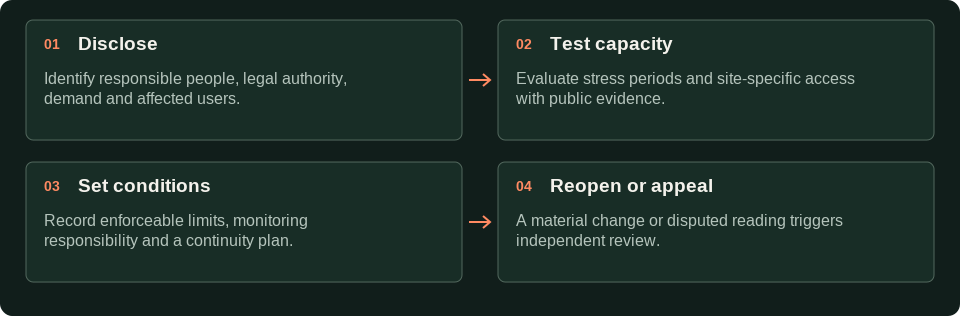
An effective rule needs a path that a small municipality can actually administer. Before approval, publish a concise statement naming the owner, the accountable decision maker, the proposed resource commitments, the scenarios used and the authority that can pause the commitment. Hold confidential personal and commercially sensitive details in an auditable regulatory file. Disclose enough about beneficial control and commitments for affected residents and workers to challenge inconsistencies. Offer accessible language, translation where needed and a route for evidence from residents who lack technical consultants.
After approval, verify the water deliveries, peak load and agreed curtailment conditions on a stated schedule. Keep a record of who can refuse new capital commitments and whether that authority was exercised when limits were approached. Require notice of material changes to the control arrangement, affected parcels or water source. Regulators should be able to demand correction, suspend an expansion, and recover the cost of monitoring or remediation from the responsible entity under the enacted framework. A sudden shutdown may jeopardize payroll or a community service. A continuity plan should preserve those obligations while preventing fresh resource commitments.
Residents and workers would receive a reasoned decision, a specified period to contest material errors, access to an independent reviewing body and a route to interim protection when delay could defeat the remedy. Applicants need the same chance to correct faulty capacity estimates or mistaken attribution. The entity would fund monitoring through a transparent charge, with rules protecting the reviewer’s independence. A public tally of upheld challenges, unresolved complaints, resource curtailments and cancelled acquisitions reveals far more about governance than a count of forms signed.
Figure 2. How a community can contest a commitment
- Disclose
Identify responsible people, legal authority, demand and affected users.
- Test capacity
Evaluate stress periods and site-specific access with public evidence.
- Set conditions
Record enforceable limits, monitoring responsibility and a continuity plan.
- Reopen or appeal
A material change or disputed reading triggers independent review.
11. What could make the framework fail?
One risk is that wealthy incumbents can hire enough reviewers to satisfy a complex rule, while a local cooperative cannot. Use a proportionate process for small purchases within a fixed budget and a full review for changes in land control, essential resource access or independent spending power. Publish common application forms and fund technical assistance for communities and small applicants. Apply the same cumulative capacity accounting to existing large operators as to new entrants when expansion is proposed. An exemption based merely on a large operator’s existing presence would entrench the concentration the policy seeks to reduce.
A second risk is that residents value useful computing services as well as food, land and water. Emergency communications, hospitals and public utilities may depend on data center capacity. When such a service is claimed to be essential, require a named beneficiary, a specification of the minimum load necessary for continuity and an independently verified plan for interruptions. Separate that protected service from discretionary growth. A public label or a small medical customer cannot automatically make every future server expansion essential.
A third risk is false precision. A water floor reflects uncertainty about demand, source reliability and drought, and a farmland designation may lag changing use. Agencies should publish the assumptions and test more severe conditions. A pilot evaluation could compare matched applications before and after adoption, recording review time, actual peak withdrawals, essential-service interruptions, displacement, distributions of costs and the success of appeals. Selection into permitting, weather, unrelated infrastructure changes and applicants moving elsewhere would complicate causal inference. Report those limitations and measure spillovers to nearby communities. The present paper offers testable criteria and arithmetic, not an estimate of the policy’s welfare effects.
12. What wealth can and cannot authorize
People can choose to use advanced computation and robotics in productive firms, farms and public services. We propose that property claims, residual profits and the authority to expand those systems remain with accountable people or human-governed institutions. Control must be visible in the decisions that matter. A model may recommend a purchase. A person with genuine discretion must own the consequences of approving it, and public authorities retain the power to refuse commitments that would undermine essential access.
The dry-day example shows why neither a human signature nor a favorable average is enough. The original design can run on an ordinary day but cannot deliver its requested load through the design stress while protecting the stated reserves. A smaller design fits under one stress assumption and fails under another. An autonomous system with effective control over reinvestment would fail the ownership criterion even on a day with plentiful water. A valid decision requires a particular project, at a particular place, within a measurable resource envelope, authorized by people whom the community can call to account.
References
- Delaware General Assembly. Delaware Code, Title 8, General Corporation Law, §§121–122. ↗
Corporate powers, including acquisition and holding of real and personal property in §122(4).
Accessed 2026-11-20 - Delaware General Assembly. Delaware Code, Title 8, General Corporation Law, §141. ↗
Board authority, statutory qualifications and requirement that directors be natural persons in §141(a)–(b).
Accessed 2026-11-20 - U.S. House Office of the Law Revision Counsel. 15 USC §7001(h), Electronic agents. ↗
Federal electronic-signature provision concerning legally attributable action in covered transactions.
Accessed 2026-11-20 - California State Water Resources Control Board. Human Right to Water. ↗
Agency account of Water Code §106.3 and drinking water, sanitation, cooking, affordability and accessibility.
Accessed 2026-11-20 - California Department of Conservation. Determining Agricultural Impacts in California and the Role of Important Farmland Maps. ↗
Describes how farmland maps inform project-level CEQA review and the responsibilities of the lead agency.
Accessed 2026-11-20 - Smith SJ, Hubbard A, Newkirk A and colleagues. United States Data Center Energy Usage Report: 2025 Update. ↗
Lawrence Berkeley National Laboratory, June 2026, report p. 8. Modeled national electricity consumption for historical year 2024.
Accessed 2026-11-20 - Shehabi A and colleagues. 2024 United States Data Center Energy Usage Report. ↗
Lawrence Berkeley National Laboratory, December 2024, pp. 55–57. Estimates of direct facility water consumption and indirect water associated with power generation.
Accessed 2026-11-20 - California Civil Rights Department. Civil Rights Council Secures Approval for Regulations to Protect Against Employment Discrimination Related to Artificial Intelligence. ↗
June 2025 agency announcement explaining approved rules on automated decision systems and existing employment discrimination protections.
Accessed 2026-11-20 - Financial Action Task Force. FATF Glossary, Beneficial Owner. ↗
Definition of ultimate ownership and effective control in the context of legal persons. Used as a governance analogy.
Accessed 2026-11-20