Matha Labs Research · Technical preprint
Earth Space Elevator Feasibility
How strong must an orbital tether be, can AI-discovered materials meet the requirement, and where could an equatorial terminal operate?
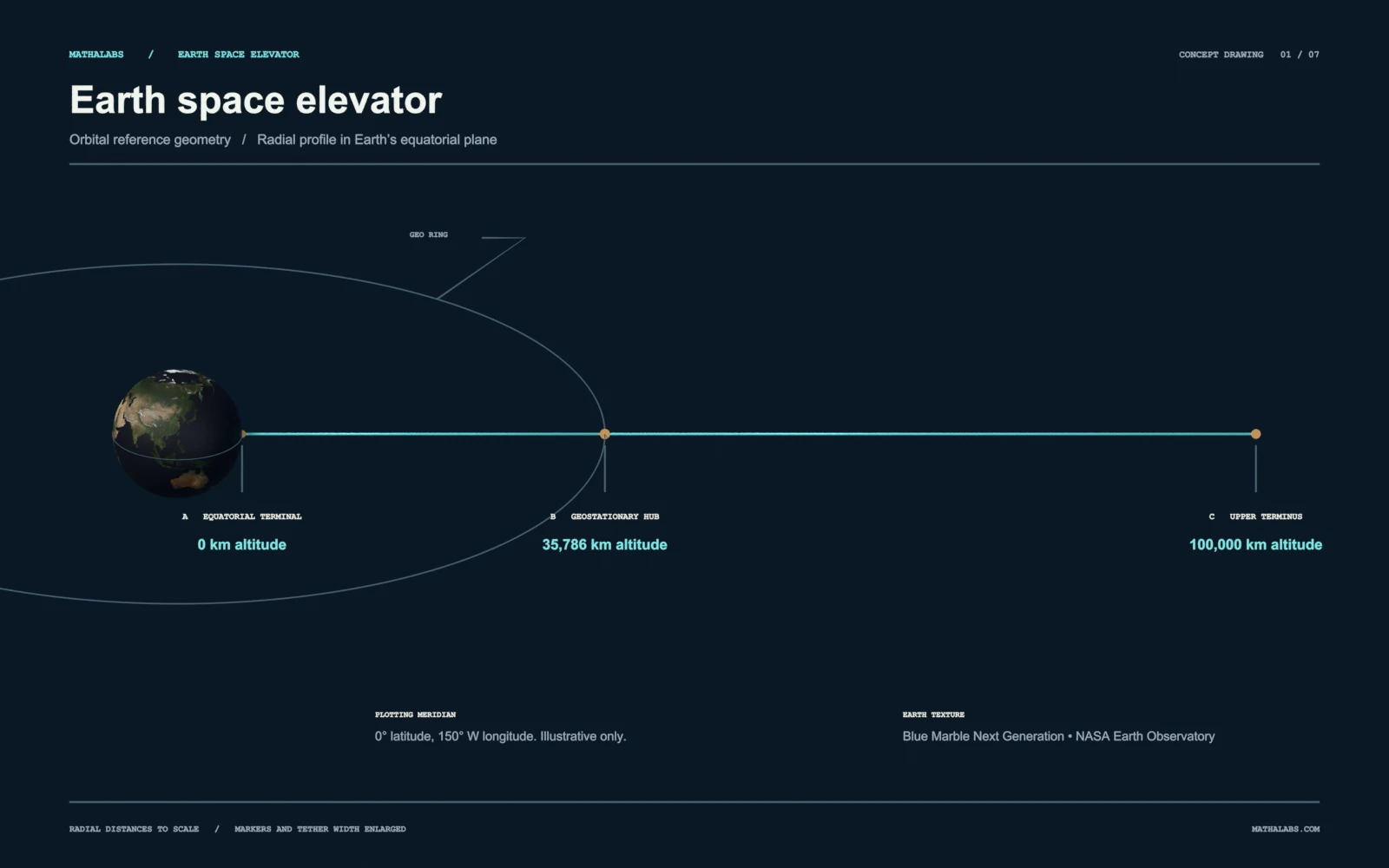
- Geostationary altitude
- 35,786 km
- Allowable strength for 20:1 taper
- 16.16 MJ/kg
- Published short-gauge CNT fiber
- 7.5 MJ/kg
- GNoME summary records audited
- 554,054
Tether physics
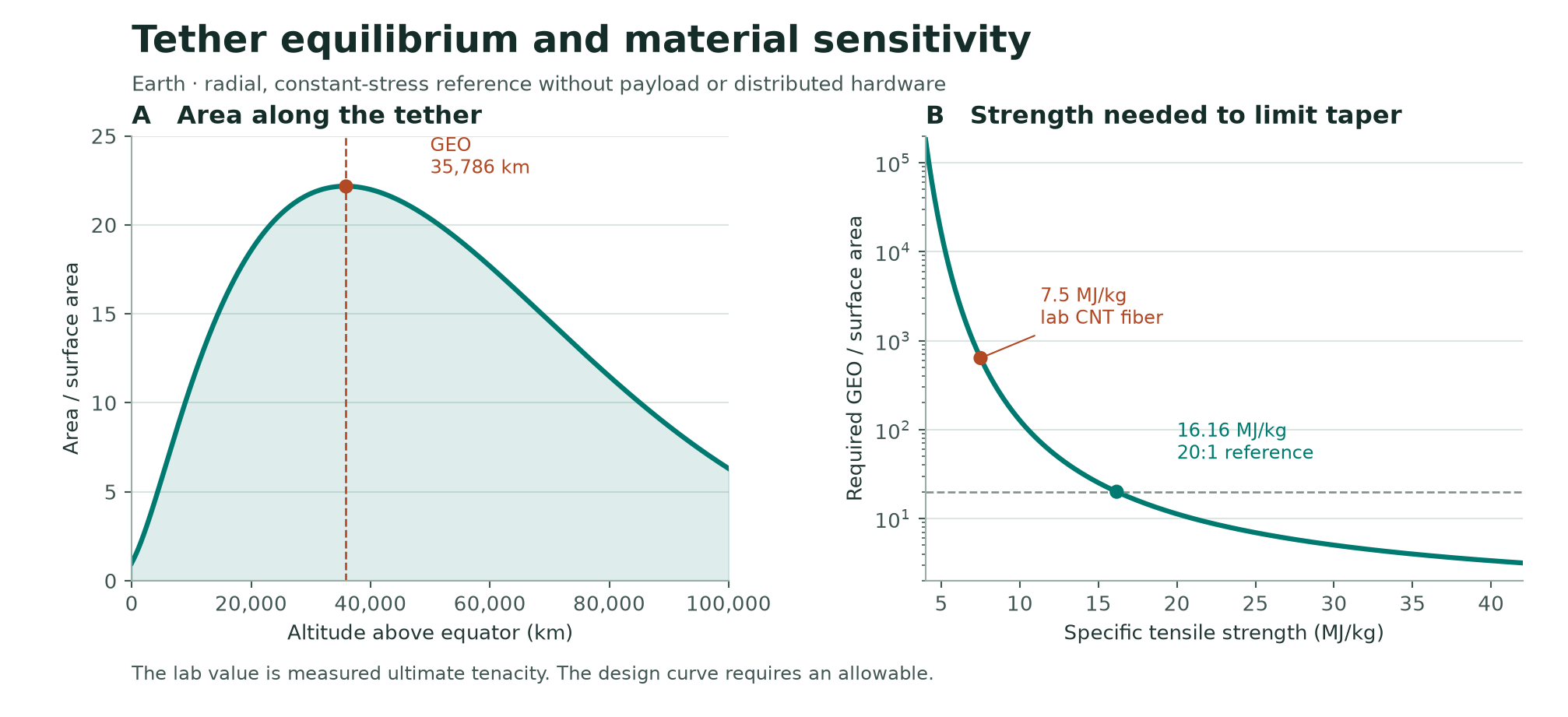
Earth’s rotation reduces the effective downward acceleration with altitude. Effective radial acceleration is zero at geostationary orbit. Above that point the outward load of the upper tether and counterweight keeps the ribbon under tension. The ideal ribbon has its largest cross section at GEO.
In the bare-ribbon model, 48.423 MJ/kg of effective work sets the taper. The GEO-to-surface cross-sectional area ratio is exp(48.423/S), where S is the allowable specific tensile strength in MJ/kg. At a ratio of 20, stainless fittings, clamps, shielding and drive hardware still need a separate mass and load budget.
The reference extends 100,000 km above the equator. At a hypothetical 25 GPa allowable, 1,600 kg/m³ density and 100 kN surface pretension, the bare ribbon and tip mass together weigh about 10,826 metric tons. That static result excludes the platform, stations and moving vehicles.
How strength changes the taper
This calculation uses the bare, static ribbon equation. The input represents an installed allowable.
What GNoME can tell us
We scanned all 554,054 rows in the pinned public GNoME summary. The density and dimensionality filter retained 117 one- or two-dimensional crystal leads at or below 2.50 g/cm³. The companion r²SCAN release provides additional calculated stability information for some entries. Both releases lack tensile test results and production-scale durability evidence.
The strongest specific-strength result in the engineering-product evidence reviewed is a 12.5 GPa short-gauge carbon nanotube fiber with measured tenacity of 7.5 MJ/kg. Treating that measured result as an allowable would imply roughly 637:1 taper. An installed lower-bound allowance must account for length, splices, load sharing, aging and damage.
Climbing with electromagnetic drive
The proposed terminal demonstrator uses a captive linear synchronous motor on a short rigid guideway. Opposed traction bogies carry the orbital reference vehicle along the flexible ribbon. Independent mechanical capture and arrest are essential in both installations.
Continuous stators or reaction strips add line mass and demand close alignment. The mass sensitivity in the paper shows that an added 6.4 g/m distributed along the entire reference ribbon nearly doubles the idealized line and tip mass. Even if the drive is feasible on a short track, installing it across the full orbital length changes the structural problem.
Where an elevator could reach the surface
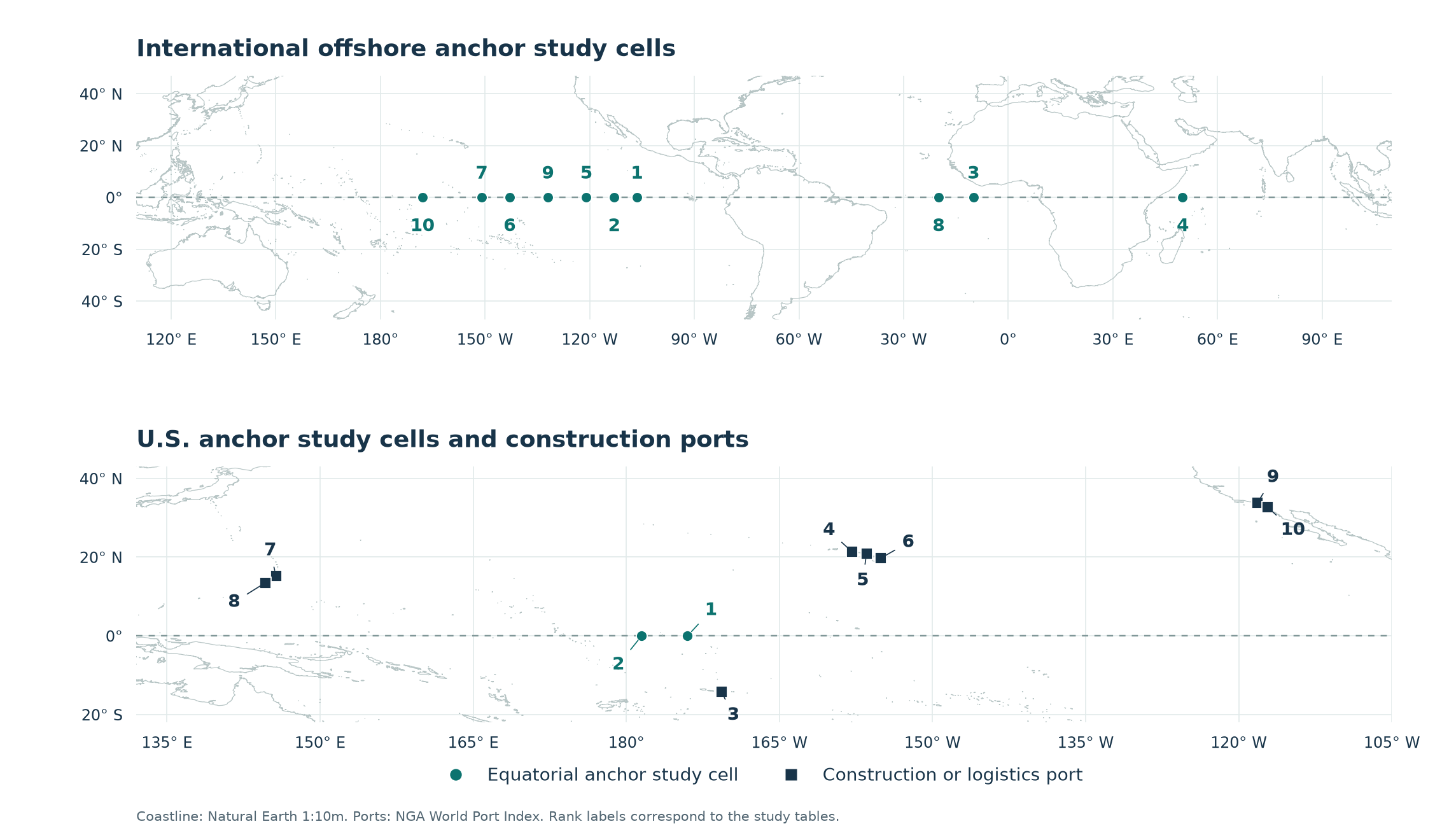
The straight Earth-fixed reference depends on a near-equatorial ocean terminal. The United States list distinguishes equatorial offshore areas from ports that could build, stage or support a platform. The international list ranks equatorial study points and corridors. Scores are comparative desk-screen results for the chosen candidates.
The eastern Pacific at 106.5°W led the offshore baseline. The central Atlantic at 10°W led when the analysis prioritized logistics. Both U.S. anchor cells are outside the desk-screened 50-nautical-mile monument boundary. Marine jurisdiction and all required authorizations remain to be established.
10 United States sites
| Rank | Site | Jurisdiction | Role | Latitude, longitude |
|---|---|---|---|---|
| 1 | Howland–Baker east | U.S. EEZ | Anchor screening cell | 0.00°, -174.00° |
| 2 | Howland–Baker west | U.S. EEZ | Anchor screening cell | 0.00°, -178.50° |
| 3 | Pago Pago | American Samoa | Logistics port | -14.28°, -170.67° |
| 4 | Honolulu | Hawaii | Logistics port | 21.30°, -157.87° |
| 5 | Kahului | Hawaii | Logistics port | 20.90°, -156.47° |
| 6 | Hilo | Hawaii | Logistics port | 19.73°, -155.07° |
| 7 | Saipan | Northern Mariana Islands | Logistics port | 15.20°, 145.68° |
| 8 | Apra Harbor | Guam | Logistics port | 13.45°, 144.62° |
| 9 | Long Beach | California | Logistics port | 33.77°, -118.18° |
| 10 | San Diego | California | Logistics port | 32.72°, -117.18° |
10 international offshore alternatives
| Rank | Site | Latitude, longitude | Nearest qualifying port | Score / 100 |
|---|---|---|---|---|
| 1 | Eastern Pacific reference | 0°, -106.50° | Manzanillo | 67.7 |
| 2 | Eastern Pacific west | 0°, -113.00° | Manzanillo | 65.5 |
| 3 | Central Atlantic east | 0°, -10.00° | Abidjan | 65.2 |
| 4 | West Indian Ocean west | 0°, 50.00° | Mombasa | 62.8 |
| 5 | East-central Pacific east | 0°, -121.00° | Manzanillo | 61.5 |
| 6 | East-central Pacific west | 0°, -143.00° | Hilo | 61.2 |
| 7 | Line Islands east | 0°, -151.00° | Hilo | 60.7 |
| 8 | Central Atlantic central | 0°, -20.00° | Dakar | 60.5 |
| 9 | East-central Pacific central | 0°, -132.00° | Hilo | 57.5 |
| 10 | Phoenix Islands sector | 0°, -168.00° | Hilo | 48.2 |
Inside the reference model
The orbital scene uses a different scale from the hardware scenes. Component dimensions represent the visualization; the paper specifies the separate analytical dimensions.
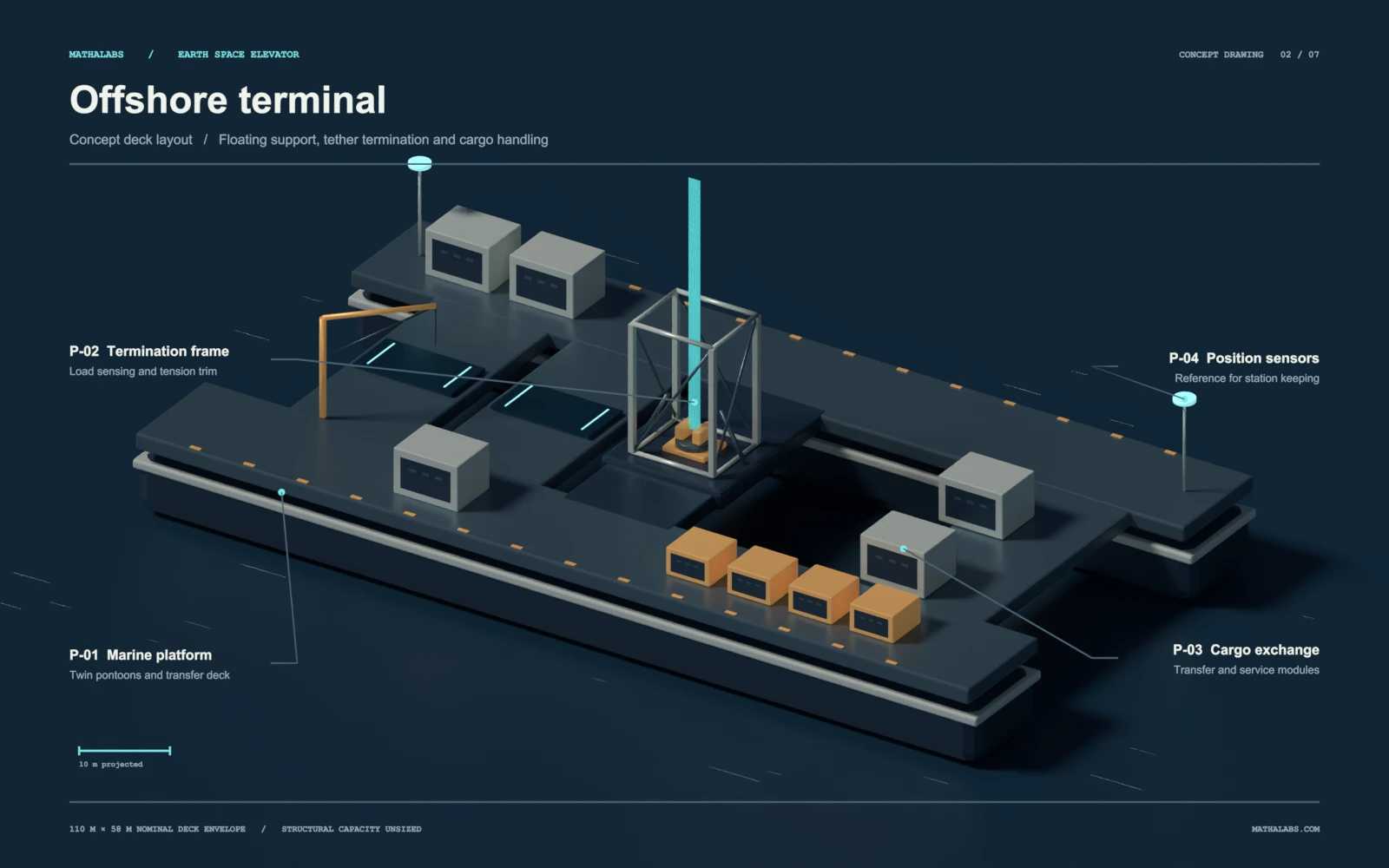
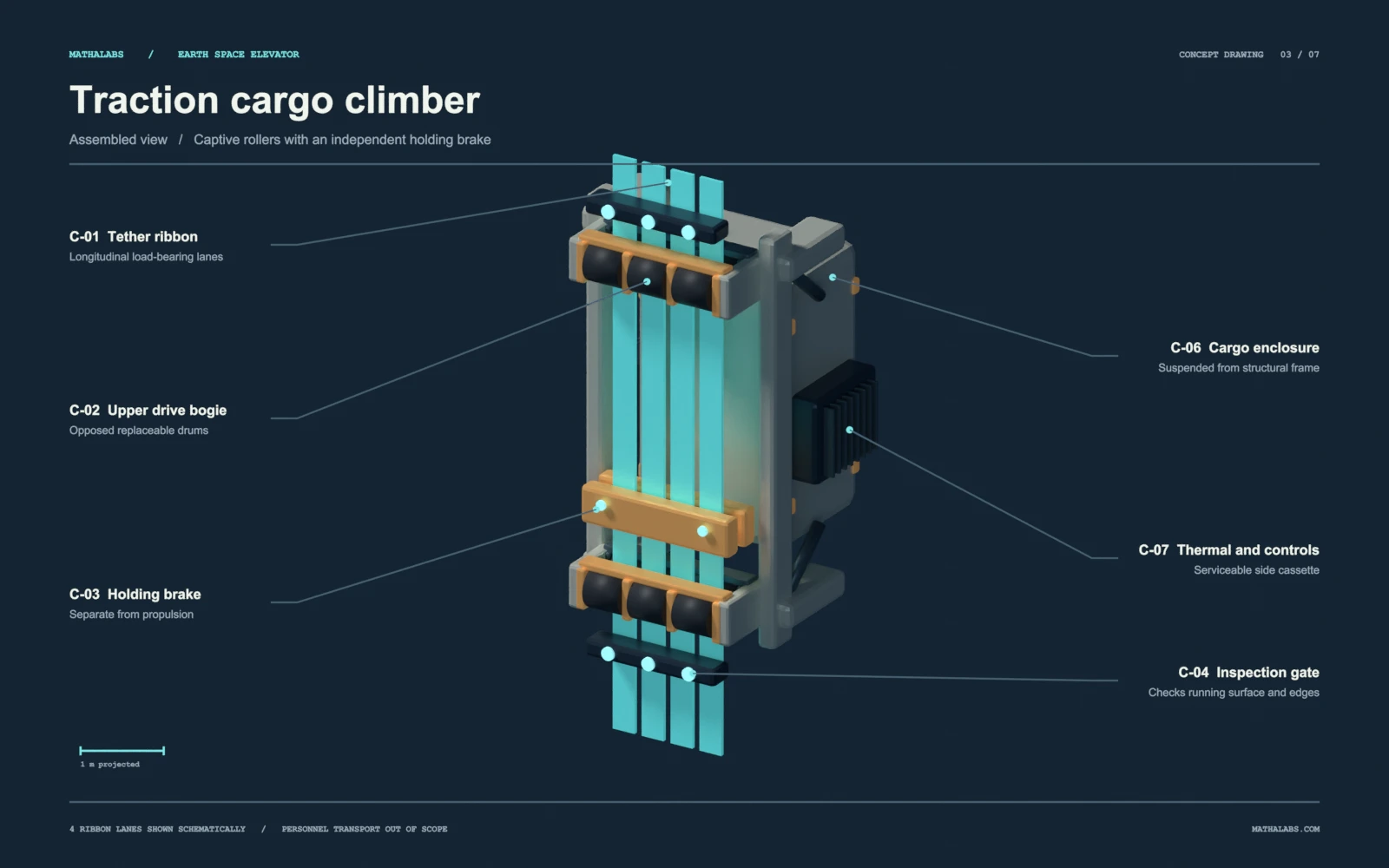
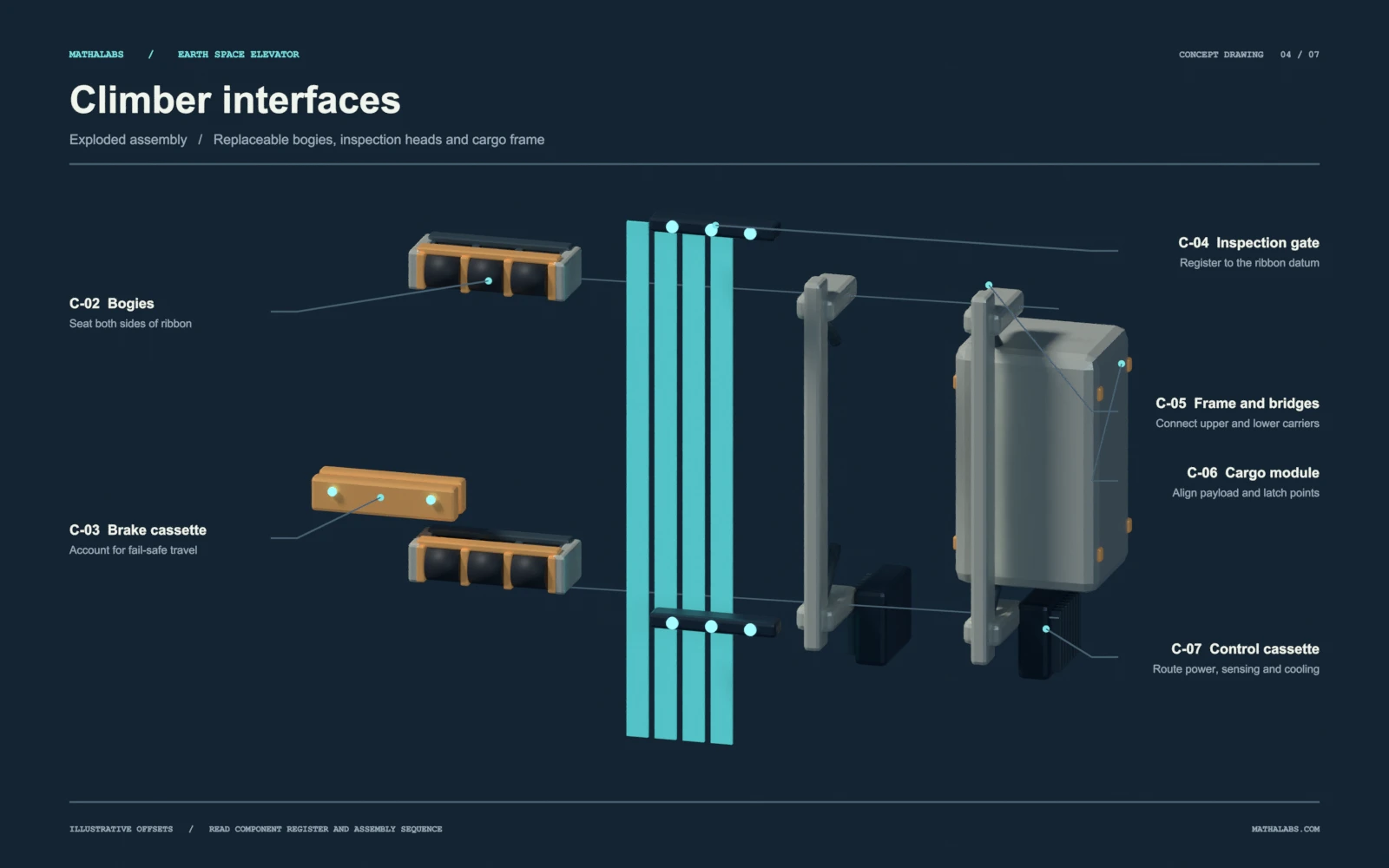
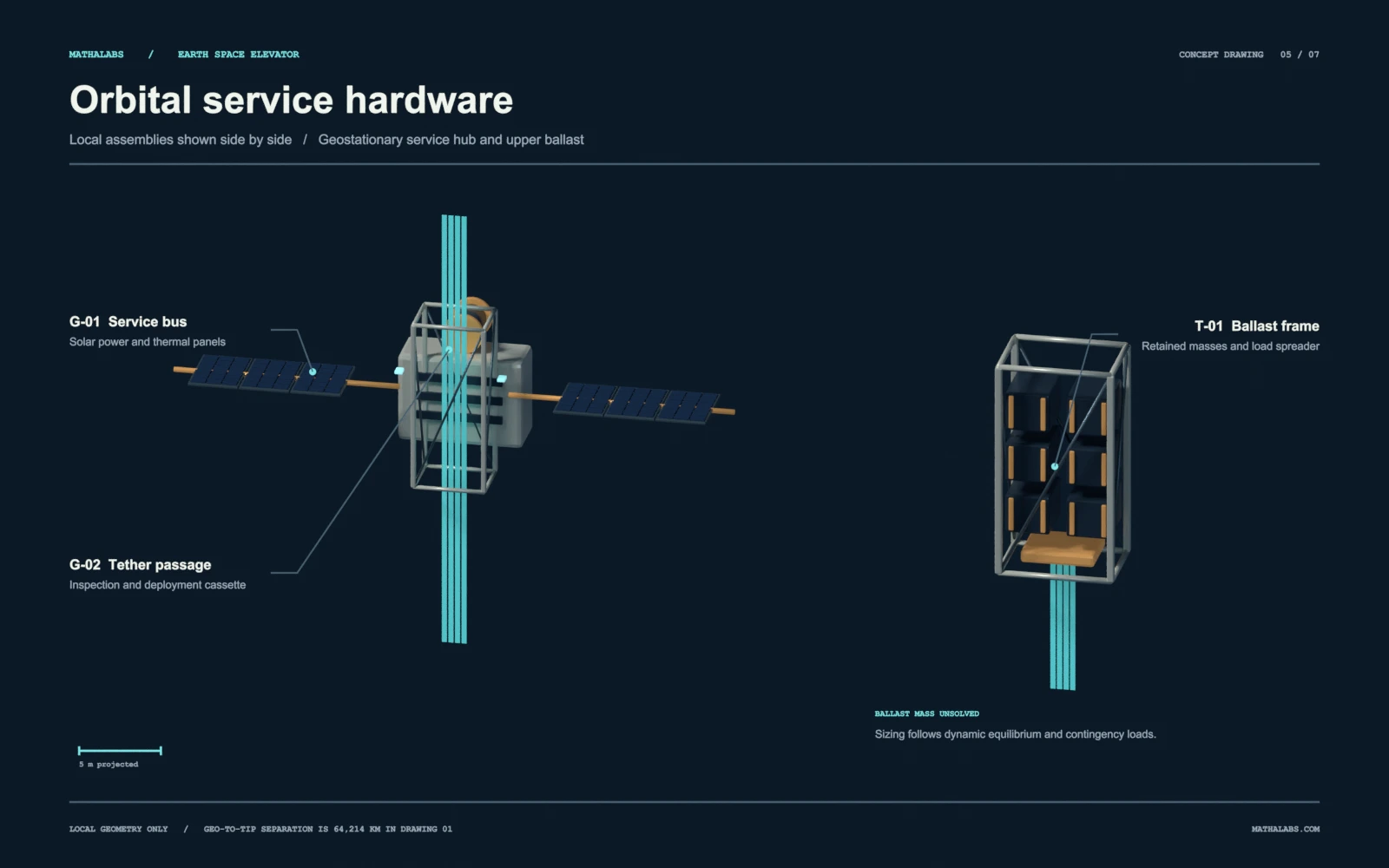

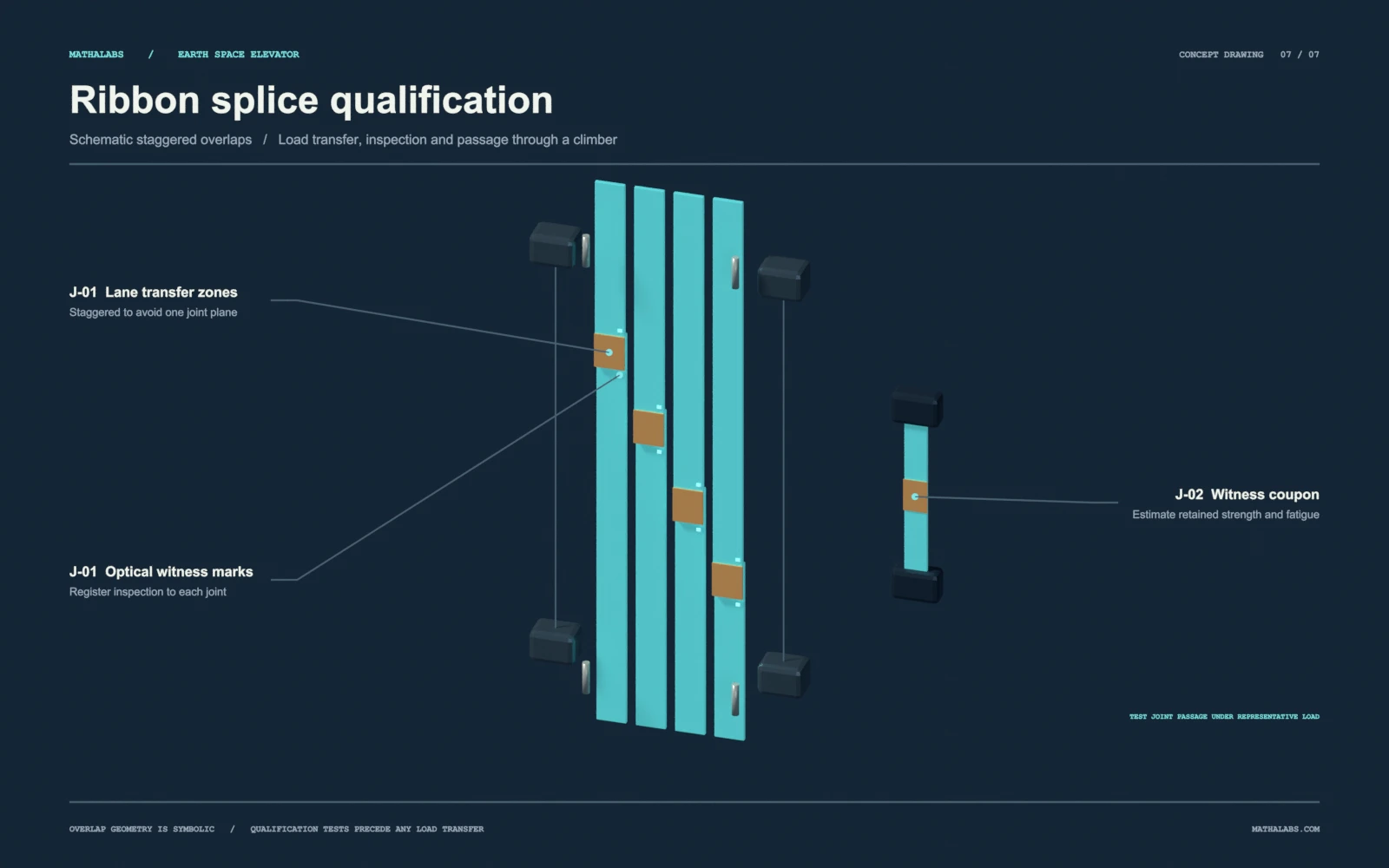
Engineering concept for uncrewed cargo. An orbital deployment decision requires qualified ribbon, dynamic validation, site permissions and an independently verified safety case.
Research files
- Research paperDerivations, experimental evidence, rankings and deployment sequence
- Blender modelSeven editable scenes covering the tether, terminal, climber and orbital hardware
- Engineering workbookEditable model inputs, tensile evidence, location rankings and catalog audit
- Reproduction packageSpreadsheets, scripts, engineering evidence, site data and assembly guide